
Heat Pumps
What to Expect When Your Heat Pump Switches From Cooling to Heating
August 11, 2026
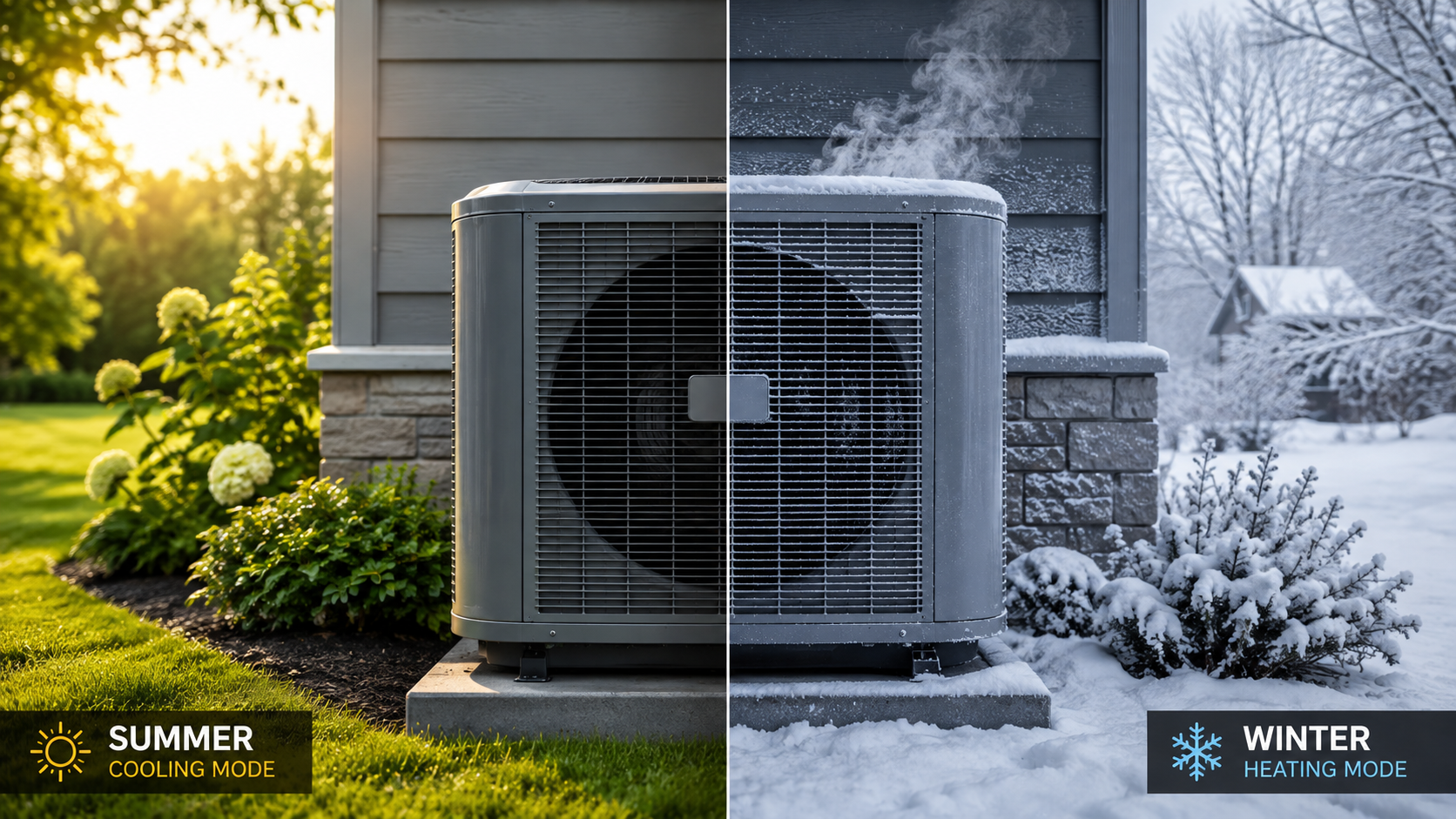
When your heat pump switches over to heat for the season, a few things happen that can look concerning if nobody's told you what's normal. Here's what to expect, what warrants a call, and why most heat pump problems trace back to installation rather than the equipment itself.
A Heat Pump Is Just an Air Conditioner That Can Reverse
Most homeowners don't realize this, but a heat pump is essentially an air conditioner. That's the base unit, cooling your home through the summer the same way a standard AC would. The difference is that it can also reverse itself in colder months, pulling heat into your home instead of just pushing it out.
Here in Canada, though, you still need backup heat for the coldest stretches of the year. That's usually a furnace, sometimes a boiler, occasionally baseboard heating. In most GTA homes I work on, that means a heat pump paired with a furnace, with the heat pump's evaporator coil sitting on top. That setup is known as a ducted system, and it's what this post is focused on.
What's Normal During the Fall Transition
Once your system switches over to heat for the season, a handful of things happen that can look like a problem if you don't know what you're looking at.
Defrost mode. Periodically, the system reverses itself briefly to melt frost off the outdoor coil. During this cycle, the outdoor unit heats up and you may see steam rising off it, sometimes enough that it looks like smoke if there's heavy frost or snow buildup. That's just moisture heating and evaporating, and it's completely normal. A hissing sound during this cycle is normal too.
Near constant, low speed running. Inverter systems are designed to run almost continuously at a low, steady speed rather than cycling fully off. That's the system operating efficiently, not struggling.
Water pooling under the outdoor unit. This is just condensation and defrost runoff draining away, nothing to worry about.
What's Not Normal
A few signs are worth calling in a technician for, not because something's necessarily broken, but because there's usually a specific reason behind them:
Ice building up on the outdoor unit that doesn't clear on its own
The unit running constantly at high speed without shutting off, while still producing little heat
Short cycling, where the system turns on and off repeatedly without ever really warming the house
Your thermostat failing to reach the set temperature, or the system kicking over into emergency heat on its own
A Number That Might Surprise You
Over ninety two percent of the service calls we get on heat pumps have nothing to do with the heat pump itself.
I've been a licensed HVAC technician for over twenty five years, working on systems across Ontario and the GTA, and I've walked into more of these situations than I can count. After properly assessing the equipment and the installation, my team and I find that the real issue is almost always the install, or mismatched equipment, not the heat pump. That mismatch tends to cost homeowners thousands down the road.
A common scenario is a home where the air conditioner was replaced with a heat pump, but the old furnace never was. Or the ductwork was never re-checked against what the new heat pump actually needs to perform properly. Heat pumps are considerably less forgiving on duct sizing than a standard air conditioning system.
When the load calculation isn't done properly at install, airflow problems follow. When an older furnace's blower and controls aren't built to communicate with a modern heat pump, inconsistent heat and short cycling follow too.
None of that is the heat pump failing you. It's the system fighting against what it was paired with, how it was installed, and air restrictions from undersized ductwork. All of it should have been addressed at the time of the sales call, before the equipment was ever sold or installed.
It's Not Just the Equipment, It's the Package
Don't let anyone tell you every heat pump is the same. The equipment matters, significantly. But installation quality being the most important factor used to be the whole conversation. While that's still mostly true, it's no longer the only piece. It's the full package: proper load calculations, correct duct sizing, a furnace or air handler genuinely matched to the system, and the quality of the company and installers doing the work.
That package is what separates years of quiet, reliable comfort from becoming one of the statistics dealing with avoidable problems.
Why It's Worth It
Heat pumps have been around for decades, but their popularity has grown noticeably in recent years, largely thanks to rebate programs that rolled out starting around 2022. Homeowners who did their homework, getting both the equipment and the installation right, are the ones seeing the real benefit.
Today's inverter heat pumps adjust output in real time rather than simply switching fully on or off. That translates to better comfort, lower bills, quieter operation, and for anyone moving away from natural gas, a meaningful drop in their home's environmental footprint.
If you're new to owning a heat pump, or still deciding whether to make the switch, this is the season to have your system looked at. Book a free in home consultation, and let's make sure your setup is built for years of comfort, not a list of regrets.
Prefer to watch this instead? Check out the video version on my YouTube channel, [The HVAC Veteran].